
The 5 most common steps in a water treatment system
A water treatment process consists of several steps that together remove contaminants and ensure that the water meets applicable requirements. In this article, we go through the five most common stages of a water treatment system. It is important to keep in mind that every project has unique requirements, which may call for customized solutions beyond these standard steps.
1. pH adjustment
Since most coagulants and flocculants are more effective within specific pH ranges, we recommend adjusting the pH before dosing any flocculants or coagulants. This improves the efficiency of the chemical reaction while ensuring the correct discharge pH and minimizing the need for downstream chemical dosing.
For pH reduction, carbon dioxide is typically used instead of strong acids, which are often corrosive and potentially hazardous to handle. For pH increase, safer workplace-friendly alternatives are recommended rather than sodium hydroxide (caustic soda).
In some systems, pH is adjusted both upward and downward to achieve optimal performance across different treatment stages.
2. Flocculation and precipitation
Flocculation
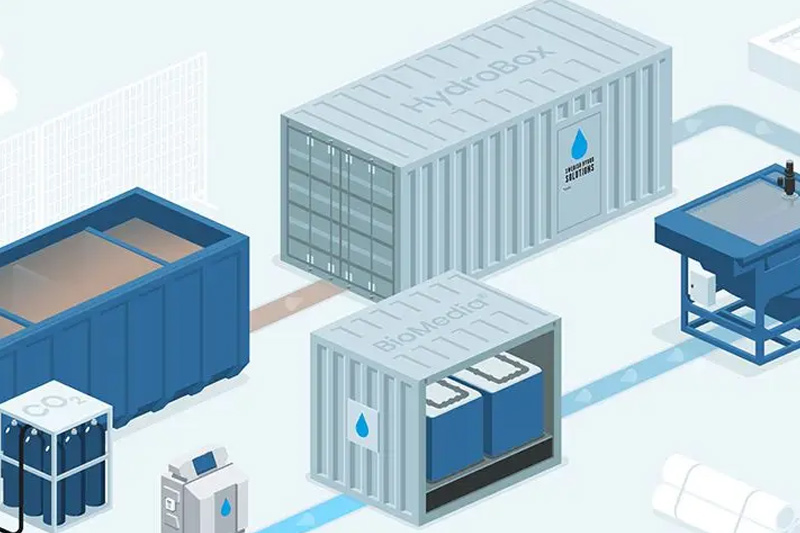
Initially, treating particles and particle-bound pollutants is often the most crucial and fundamental step in the treatment process. Effective particle separation typically requires some form of flocculation (and possibly precipitation, see below), often combined with sedimentation. The principle involves adding flocculants to cause fine particles to form larger aggregates, called “flocs,” which then settle in a sedimentation volume – usually in sedimentation containers, lamella separators, or ponds. Here we use our biodegradable flocculant agent, chitosan, which is dosed within our HydroBox.
Precipitation
For treating dissolved pollutants, a combination of precipitants and some form of filtration is usually used. Precipitation agent often involves both flocculation and precipitation and is dosed before the sedimentation step (see above), causing the dissolved substances to “precipitate” into particles that then flocculate with other particles. The flocs then sediment in a sedimentation volume, following the principle described above.
Precipitation can also be achieved by varying the pH level of the water. However, some dissolved substances require some form of filtration. This can include carbon-based sorption filtration (activated carbon, BioMedia®), where the principle is that the filter media consists of materials with extremely small pores to which dissolved pollutants can bind.
For particularly difficult contaminants, specialized solutions are required. One example is our proprietary treatment agent RedOx3, which converts highly water-soluble hexavalent chromium into trivalent chromium—a less soluble form. This enables effective removal in subsequent treatment stages.
3. Sedimentation
Sedimentation follows flocculation and coagulation. It is a fundamental process that removes particles and particle-bound contaminants by allowing flocculated particles to settle to the bottom of sedimentation containers or lamella separators, forming sludge and separating solids from the water. The clarified surface water is then directed further through the treatment system.
In some projects, pre-sedimentation is also included as part of the pH adjustment stage to quickly remove coarse particles and reduce the load on downstream processes. Our containers are also equipped to separate oil at this stage.
By integrating flocculation via our HydroBox, the sedimentation process is significantly enhanced.
4. Filtration
After precipitation and sedimentation, filtration is often used as a polishing step to remove remaining particles and dissolved contaminants. By selecting filter media with different properties, filtration can be tailored to target specific contaminants, such as metals, organic compounds, and PFAS.
We provide filtration solutions adapted to project needs, including open filter beds, pressurized filtration systems, and modular filter containers. Pressurized filters are particularly suitable for high flow rates or strict treatment requirements and enable efficient removal of difficult-to-treat contaminants.
Examples of filter media and their properties:
Activated carbon (GAC): A highly porous material with a large surface area that effectively adsorbs organic pollutants and PFAS (especially long-chain compounds such as PFOA and PFOS).
BioMedia®: Similar to activated carbon but with a surface chemistry that enhances contaminant binding capacity. It is an environmentally friendly filter material with high surface area and strong sorption properties. BioMedia® removes heavy metals such as copper, lead, and zinc, as well as organic contaminants ranging from oil-based to chlorinated compounds.
Ion exchange resins: Selectively bind PFAS, including short-chain variants such as PFBA and PFBS, where activated carbon is less effective. Often used in combination with other media to achieve very low discharge limits.
Sand filters: A physical filtration method that removes particles and particle-bound contaminants by passing water through a granular media barrier, improving clarity and reducing suspended solids. Sand or glass media is selected based on project requirements.
Oil absorbents: Environmentally friendly absorbents that effectively bind oil-based liquids and hydrocarbons while repelling water. Unlike traditional polypropylene absorbents, they encapsulate oil within cellulose fibers, preventing leakage and runoff.
5. Monitoring and sampling
Real-time monitoring and continuous flow-proportional sampling throughout the project are often critical to obtaining accurate data over time. This allows for performance tracking, early detection of deviations, and adjustments to meet discharge requirements.
Collected and documented measurement data is used to verify system performance and is reported to regulatory authorities or local municipalities.
Do you need more technical information?
Equipment
Here you’ll find our full range of water treatment equipment — solutions designed for reliable performance, safe operation, and effective handling of project needs.
Do you have questions about water treatment?
Want to learn more about the different technologies or have follow‑up questions?
Feel free to contact us — we’re here to help you sort out any questions you may have.