

Unsure about what you need?
Contact one of our experts and we will help you move forward.
What is mobile water treatment?
Mobile water treatment means that the treatment equipment is movable and can be temporarily established on a construction site or industrial area – as opposed to a permanent, site-built installation. Mobile water treatment is used to treat dewatering water generated by, for example, excavation, blasting, drilling or groundwater ingress, so that after treatment it can be discharged to a recipient or the stormwater network. Our technology is today so well-established that it is recognised as BAT (Best Available Technique) and frequently forms the basis on which authorities set discharge requirements for temporary water treatment projects.
How mobile water treatment is used
Every construction project requires treatment of the dewatering water that invariably arises from activities such as excavation, groundwater ingress, blasting or drilling. The treatment system must naturally be capable of handling both particle-bound and dissolved contaminants to a satisfactory standard — but it is equally important to plan for water treatment across all phases of the project from an early stage. This is partly because the different work activities affect water quality and the contamination profile in different ways, and partly because the system sometimes needs to be relocated.
Projects in urban environments place very high demands on mobility and logistics planning. In some larger contracts — such as Västlänken Centralen — the construction advances like a moving factory, with new excavations constantly being opened and new concrete pours taking place. The water treatment system must therefore be able to move forward in step with the project. Pumping water over long distances carries far too many risks, given the potential for hose failures, pressure drops and construction traffic on site.
In a large contract, work activities often run in cycles, and ahead of each restart the equipment must be able to be relocated and reconnected within a short timeframe. For this reason, water treatment systems from Swedish Hydro Solutions are designed to be as plug-and-play as possible. Our modular units are connected using standard couplings, and the automatic control units in our HydroBox are connected via a single three-phase connector. Our container-based units can also be stacked.

Mobile water treatment on the E6, Mölndal. All equipment was established within a short time window during a traffic closure. The railway tracks are visible in the background.
On confined sites such as Korsvägen in Gothenburg, the water treatment system competes for space with every other activity on site — crane lorries, haulage routes, equipment and storage areas, with deliveries arriving constantly.
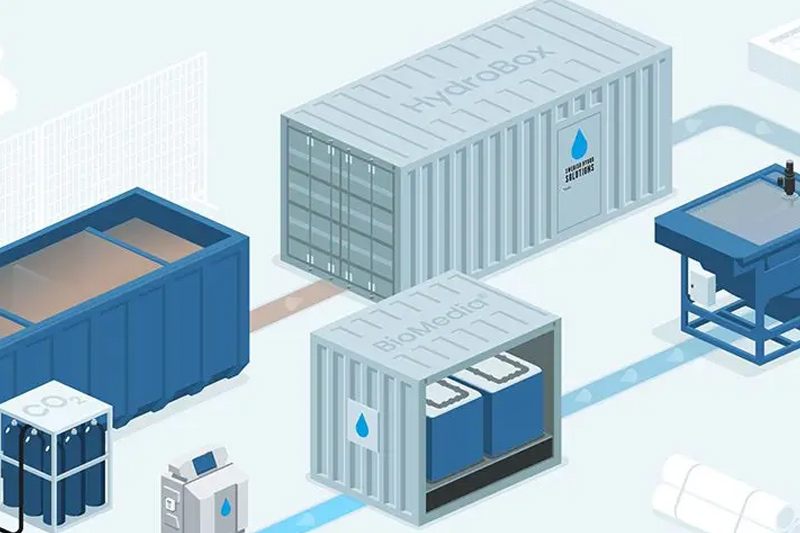
When it is time to move the system, it has to happen quickly — within hours, not days. All components in Swedish Hydro Solutions systems are therefore fitted with robust integrated lifting points, or can be handled by a hook-lift vehicle. All pipe and hose connections are managed with standardised quick couplings, and all automatic control and dosing is handled from our HydroBox — a standard 10 or 20-foot container. We also offer lamella separators that handle sedimentation far more space-efficiently than a conventional sedimentation container.

Looking for equipment?
Equipment
Here you’ll find our full range of water treatment equipment — solutions designed for reliable performance, safe operation, and effective handling of project needs.

Need help planning?
Contact us and we will help you move forward.
Why mobile water treatment from Swedish Hydro Solutions?
Swedish Hydro Solutions can offer complete water treatment contracts. When you contact us, you receive concrete guidance and advice. We help you navigate water types, contaminants, equipment and discharge requirements so that you can find the right solution for your project. We can also help you plan your project so that you can cost it correctly from the outset — and avoid the most common pitfalls.
- Experience: We have over ten years of experience planning and delivering all types of projects across all types of industries.
- Meets all requirements: Many regulatory authorities base their requirements on our technology. You can therefore be confident that the solution you order from us will meet the applicable discharge requirements.
- Flexible and scalable: The components in our systems are modular and designed to work together. Our systems can be easily adapted as needed — whether new contaminants emerge or the system needs to handle a higher flow rate.
- Service and support: We ensure that your equipment receives regular servicing — carried out by the same personnel who built the system. Our project managers are present throughout every phase of your project.
Swedish Hydro Solutions is ISO certified
Swedish Hydro Solutions holds ISO certification in accordance with 9001, 14001 and 45001. This means we have clear processes in place to follow up and document both our working methods and what we deliver — enabling us to work in a structured and purposeful way to provide solutions that work in practice and create long-term value for you as a client.
More about planning
Read more about what you need to consider before your project gets underway. There are several factors that influence what type of mobile water treatment you will need.
Reference projects: Why planning matters
Mobile water treatment requires planning and close dialogue between all parties involved. But during any project, things happen that are difficult to predict. A geotechnical survey may suddenly be required to assess ground stability before a system can be relocated. New contaminants may be encountered unexpectedly. A concrete pour may affect pH levels earlier than anticipated. An excavation may reach below the groundwater table, bringing a different set of regulations into play.
In short — a water treatment project is a living thing, and the conditions change along the way.
Thorough planning matters, because it is also what ensures that production can continue without interruption. The better the dialogue, the fewer the disruptions. On this page we have selected a number of projects that are particularly interesting from exactly that perspective.
Interesting reference projects
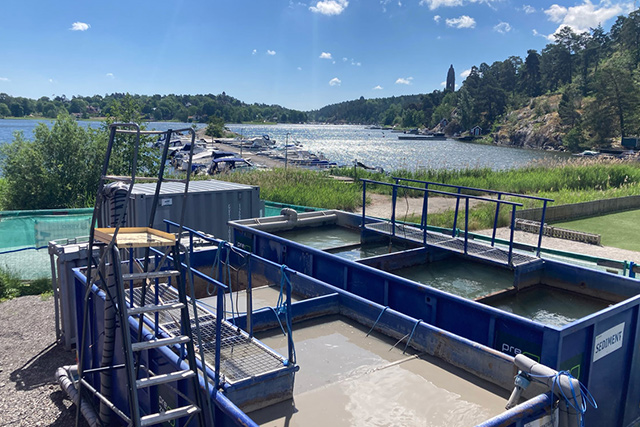
The new Näckenbadet
Open dialogue, creative solutions, and Nacka Municipality’s clear communication about the site’s history enabled an efficient full‑scale water treatment setup.

West Link – Central station
Project Centralen is NCC’s largest contract to date, part of the West Link in Gothenburg, where Swedish Hydro Solutions managed the water treatment.
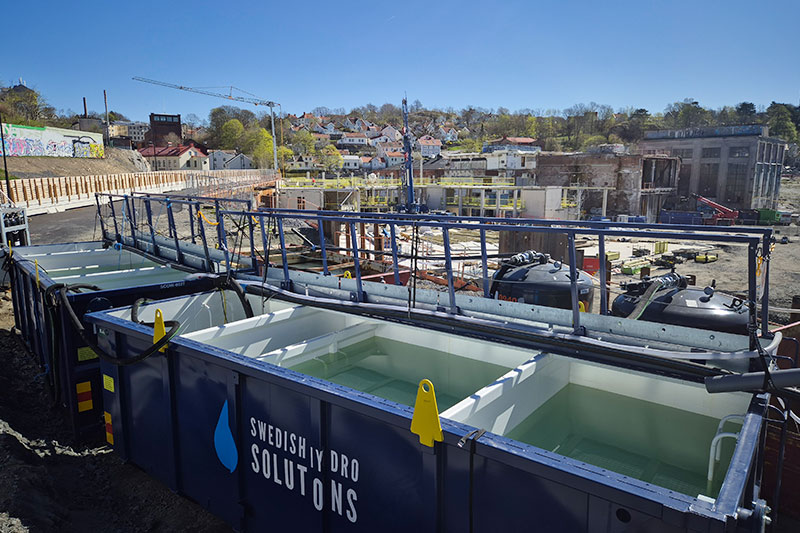
Water treatment established in Forsåker, Sweden
Swedish Hydro Solutions has established a treatment system in Block 39, Forsåker, Sweden, treating dewatering from excavation and concrete works.
Our mobile water treatment in numbers
(From Kiruna in northern Sweden to Malmö in the south)
completed projects
%
Construction
%
Industry
%
Recycling
PFAS-related projects
1 800 000 m³
of water treated in our systems every year
(One point eight billion litres…)

Want to know how our technology works?
Contact one of our experts and we will help you move forward!
How it works: Technology, equipment and the treatment process
Every project has its own unique conditions. We always tailor the treatment process to the specific contaminants present in your water and the requirements set by the supervisory authority. The process is based on a mechanical and chemical flow through closed, reliable systems.

- Flow control and pre-sedimentation: Incoming dewatering water is pumped into the system, where coarse particles are initially separated.
- Automated chemical dosing (HydroBox): The water passes through our HydroBox (10 or 20-foot container), where flocculant is dosed fully automatically based on real-time measurement of flow and water quality. This binds dissolved metals and particle-bound contaminants.
- Space-efficient sedimentation (lamella separator): The water is directed into our compact lamella separators, where flocculated particles sink rapidly to the bottom — requiring a fraction of the footprint of a conventional sedimentation container.
- Final filtration (polishing): Where required, the water is polished through media filters (such as sand or activated carbon) to capture the final microscopic particles or oil residues.
- Digital online logging and sampling: Regulatory authorities require full traceability. The system uses automatic, flow-proportional sampling. All measurement data — including pH and turbidity — is logged digitally and can be monitored online in real time to ensure that no limit values are exceeded.
- Service and support: All contract equipment requires regular servicing and maintenance, and water treatment equipment is no exception. When you enter into a service agreement with us, you receive exactly the support you need, at the right time. All our service technicians are trained to maintain our systems.

Is all water treatment mobile? (The legal definition)
The term “mobile water treatment” as used in, for example, tender documents carries a specific legal meaning under the Swedish Environmental Code. It defines the water treatment as a temporary measure in which discharges are short-term in nature — distinguishing it from permanent, site-built installations.
The term is also associated with temporary requirements relating to turbidity, pH and toxicity, as well as more frequent sampling obligations. When discharge limit values are established for a contract involving mobile — that is, temporary — water treatment, emissions are also assessed against the parameter of time, although it is naturally the sensitivity of the recipient that remains the governing factor.
Differences between mobile water treatment and a permanent installation
When a treatment system is classified as mobile and temporary, both the legal framework and the practical requirements differ from those applicable to a permanent installation. Authorities weigh the risk of acute environmental impact over a shorter period against the fact that the activity will soon cease. The differences fall into four main areas:
- Permitting processes and legislation: Permanent installations often require lengthy environmental court proceedings and planning permission. For mobile systems, faster and more flexible approvals are granted.
- Setting of limit values: Permanent installations are subject to ongoing requirements based on environmental impact over time, with the accumulated risk assessed in relation to the sensitivity of the recipient. Mobile water treatment is subject to temporary requirements designed to prevent short-term harm.
- Sampling: Permanent installations — at landfills or industrial facilities, for example — almost exclusively require automatic, flow-proportional sampling and analysis by an accredited laboratory. For a mobile system, sampling for parameters such as turbidity and pH must be carried out frequently or continuously, as contamination levels can vary considerably from day to day depending on rainfall or the type of work being carried out. Sampling is automatic and flow-proportional, as supervisory authorities require full traceability.
- Technical requirements: For permanent water treatment installations using containers, structures must be in place to capture any potential leakage, including from chemical dosing. For mobile water treatment, the requirement is that the site must be restored to its original condition upon completion.
Frequently asked questions about mobile water treatment (FAQ)
Can we rent a system from you?
We offer complete rental solutions tailored to the length of the contract, as well as individual components where required. Many of our clients prefer a full turnkey arrangement where we take responsibility for design, installation, commissioning, chemical supply, servicing and ongoing supervision throughout the project — but the setup varies depending on your needs.
What is the lead time for a mobile system?
Because our systems — HydroBox, lamella separators and filtration units — are standardised and modular, we can often mobilise hardware quickly. The actual lead time is usually determined by how long sampling, water analysis and regulatory dialogue take in the early stages. Contact us well in advance to secure your establishment.
How much space does the equipment require on site?
Our equipment is built for confined urban environments. By using highly space-efficient lamella separators instead of bulky sedimentation containers, and by designing our containers to be stackable, we can often reduce the footprint required by traditional solutions by more than half.
What site preparations are required before installation?
The systems are designed to be as plug-and-play as possible. What is needed on site is a hardstanding, level surface, access to power (typically 32A or 63A three-phase depending on the size of the system), and pipework or hoses run for raw water intake and treated water discharge to the recipient or drainage network.
What happens if conditions change during the project?
We dimension our solutions with flexibility in mind and can adjust the technology or capacity if flows or contaminants change during the course of the project.
Want to know more about mobile water treatment?
Need to know more or have questions about your specific project? Get in touch and we’ll help you move forward — everything starts with a conversation.