
At a workplace of this scale, managing significant water volumes, waiting for sedimentation isn’t feasible. Within seconds, I could see the particles aggregating and settling to the bottom.
— Tony Elggren, Site Manager, PEAB

Sedimentation tanks
Our sedimentation containers are designed to achieve the optimal balance between flow rate and settling velocity. They can be used both for pre-sedimentation and as primary sedimentation tanks.
Several models are optimized with integrated overflow and underflow baffles. These enhance the sedimentation process and also support the separation of potential oil contaminants during water treatment.
The containers are built to standard dimensions and can be easily transported by both truck and vessel. They are designed for efficient loading and unloading and are equipped with lifting lugs, allowing placement even on confined job sites.
Available sizes
- 8 m³ – L 4035 x W 1941 x H 1580 mm (approx. 1,020 kg)
- 24 m³ – L 6283 x W 2476 x H 2146 mm (approx. 2,690 kg)
- 36 m³ – L 6000 x W 2532 x H 2815 mm (approx. 4,100 kg)
Lamella clarifiers
Swedish Hydro Solutions’ lamella separators provide efficient sedimentation of particle-bound contaminants and are available in various sizes, tailored to specific flow requirements.
One key advantage is their compact design and small footprint, while the lamella plates significantly increase sedimentation efficiency. At job sites where space is often limited, lamella separators are an effective solution.
Sludge is collected in the hopper and removed using an integrated sludge scraper and sludge pump, ensuring that the sedimentation surfaces remain efficient over time.
Available sizes
We offer lamella separators with a projected settling area ranging from 20 to 52 m², and larger units can be manufactured upon request. Thanks to the modular design, treatment capacity can also be increased by operating multiple units in parallel.


Sedimentation in the treatment process
Our sedimentation containers and lamella clarifiers are available for both rental and purchase. They can be used as standalone solutions or as a treatment step within a complete water treatment system.
To enhance the sedimentation process, the solutions can be combined with HydroBox. Through coagulation and flocculation, very fine particles bind together to form larger and heavier flocs that settle more quickly and can be removed from the water more efficiently.
When higher treatment performance is required, or when the water contains multiple types of contaminants, sedimentation is often combined with downstream filtration, such as BioMedia® filtration.
Frequently asked questions about sedimentation tanks and lamella clarifiers (FAQ)
Can I rent a sedimentation tank form you?
Yes, we offer both sedimentation containers and lamella separators for rental. The units can be rented as standalone solutions or as part of a complete water treatment system. They are also available for purchase.
When should I choose a sedimentation container instead of a lamella clarifier?
A sedimentation container is often a good choice when sufficient site space is available and flow rates are low to moderate.
A lamella clarifier is typically used when available space is limited or when large flow rates need to be treated. A lamella clarifier can provide the same sedimentation capacity as several conventional sedimentation containers while requiring significantly less footprint. For example, a lamella clarifier with an effective settling area of approximately 40 m² can provide sedimentation performance equivalent to about three 24 m³ sedimentation containers.
Lamella clarifiers are also advantageous in projects where large volumes of sludge are expected. With an integrated sludge scraper and sludge pump, accumulated sludge can be removed continuously, reducing the need for tank cleanouts, simplifying operation, and often providing a more cost-effective solution.
What flow rate can a sedimentation container or lamella separator handle?
The flow rate that a sedimentation container or lamella separator can handle depends on the water quality, the concentration of suspended solids, the presence of other contaminants, and the applicable discharge requirements. For sedimentation containers, a hydraulic retention time of approximately 2-3 hours is generally recommended, while lamella separators are typically sized based on surface loading rate (m/h).
We offer sedimentation containers ranging from 8 to 35 m³ and lamella separators with a projected settling area ranging from 20 to 52 m² for rental. Larger units can also be manufactured upon request.
Is a sedimentation container sufficient to treat the water?
Sedimentation is a fundamental step in water treatment, but it is often not sufficient as a standalone treatment process. The appropriate solution depends on several factors, including water quality, the concentration of suspended solids, the presence of other contaminants, and the applicable discharge requirements.
In many cases, additional treatment processes such as coagulation and flocculation, pH adjustment, or filtration are required to achieve the desired treatment performance.
Not sure which solution is best suited for your project? Feel free to contact us at info@swehydro.com for advice and guidance.
You can also learn more about our FlocBox, a compact plug-and-play solution that combines four treatment stages in a single unit. FlocBox has been specifically developed for construction and civil engineering projects and is used when treatment requirements exceed what can be achieved through sedimentation alone.
What is the lead time?
Lead times vary depending on the equipment selected, the quantity required, and current availability. For an accurate lead time estimate, please contact us at sales@swehydro.com or +46 (0)10 263 36 63.
Have additional questions or need help choosing the right solution?
Contact our water treatment specialists for advice on sedimentation containers and lamella separators. We can help you identify the most suitable solution for your project.
Projects
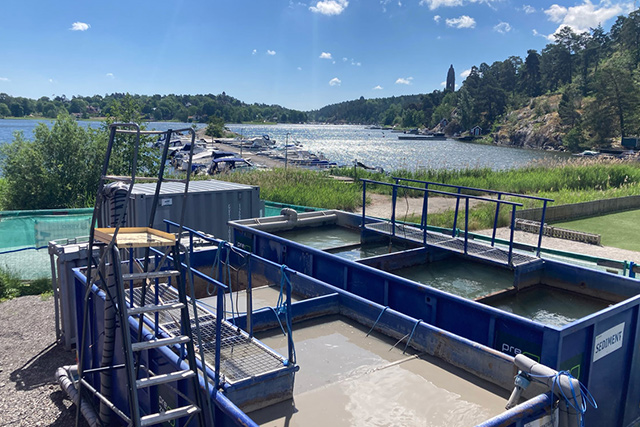
The new Näckenbadet
Open dialogue, creative solutions, and Nacka Municipality’s clear communication about the site’s history enabled an efficient full‑scale water treatment setup.

Johannelund
Over 750 liters of turbid water with chromium entered the Johannelund tunnel each minute, and treatment still reduced hexavalent chromium by 82%.
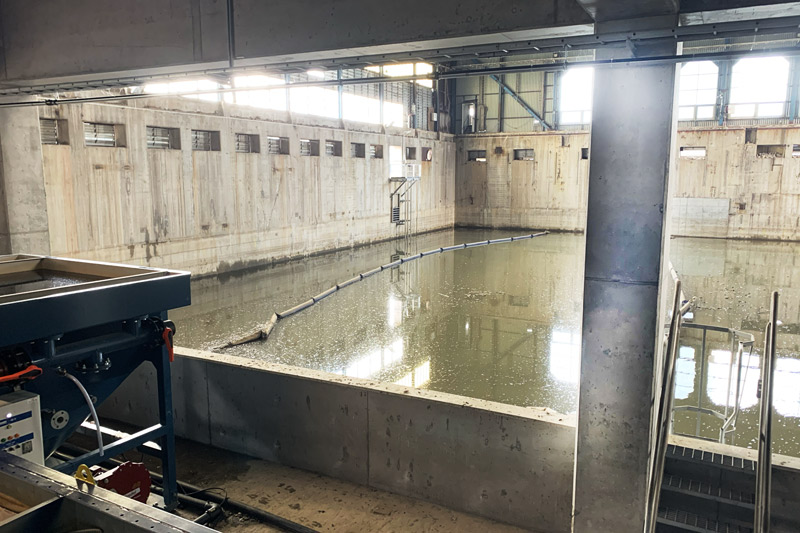
Stena Recycling
Stena faced high volumes of industrial stormwater after a new retention pond was taken into operation, requiring a robust and reliable treatment setup.