
Long PFAS chains
PFAS are a group of highly fluorinated substances that exist in thousands of different forms. What they have in common is the strong bond between carbon and fluorine, which makes them extremely persistent in the environment. But not all PFAS behave the same. One of the most important distinctions is the length of the carbon chain — that is, the number of carbon atoms in the backbone of the molecule.
When referring to long PFAS chains, this typically means substances where the perfluorinated segment consists of eight or more carbon atoms. Some of the best‑known examples are PFOA and PFOS. These compounds have long been used in everything from firefighting foams to textile treatments and food‑contact materials.
PFAS encompass thousands of substances with varying chemical structures, but the factor that most influences how they behave in aquatic environments — and how they can be treated — is often the length of the carbon chain. Long‑chain PFAS (≥ C8 for carboxylates and ≥ C6 for sulfonates) differ significantly from short PFAS chains in terms of toxicity, mobility, and treatability.
Why are long PFAS chains problematic?
Long‑chain PFAS are particularly concerning from a health and environmental perspective. They bind strongly to proteins in blood and tissues, which means they accumulate in the body over time. They are also more prone to bioaccumulate in the food chain compared to short PFAS chains. Research has shown associations with several negative health effects, including impacts on the immune system, liver, and reproductive health.
In the environment, long‑chain PFAS tend to bind to particles and organic material, allowing them to be retained in soil and sediment for very long periods.
Difference compared to short PFAS chains
To reduce risks, many long‑chain PFAS have been banned or phased out. They have largely been replaced by short PFAS chains with six carbon atoms or fewer. These substances are generally more water‑soluble and therefore spread more easily in soil and groundwater. Although they do not bioaccumulate to the same extent as long‑chain PFAS, they are still highly persistent and difficult to break down.
What does this mean for water treatment?
For those procuring water treatment, this means it is not enough to focus solely on well‑known compounds such as PFOS and PFOA. Short PFAS chains must also be addressed, but the long‑chain substances remain important to consider — both because of their severe health impacts and because they may still be present in soil and water long after their use has ended.
When it comes to treatment, long‑chain PFAS are generally easier to capture than short PFAS chains. Their stronger tendency to bind to solid materials means that long‑chain compounds often adhere more effectively during treatment, whether using activated carbon, ion‑exchange media, or membrane technologies.
The challenge is that long‑chain PFAS often appear together with short PFAS chains. For this reason, a modern water treatment solution must be capable of handling the full spectrum of PFAS — not just the compounds that are easiest to remove. For procurement processes, this means placing requirements on documented performance for both long‑ and short‑chain PFAS.
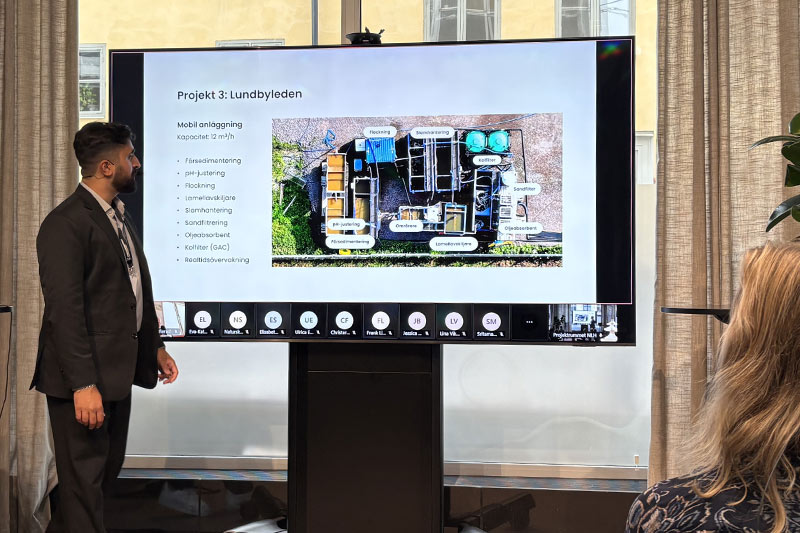
Aakash Khanna from Swedish Hydro Solutions is giving a presentation on PFAS treatment at Mistra TerraClean.
Adsorption on activated carbon
Activated carbon is one of the most widely used technologies for PFAS treatment. Here, the length of the PFAS chain plays a direct role:
- Long PFAS chains adsorb more effectively because their hydrophobic segments interact more strongly with the carbon surface.
- Short PFAS chains pass through more easily, as their higher water solubility reduces their interaction with the carbon surface.
For long‑chain compounds, carbon filtration can therefore work very well, but for short PFAS chains, significantly larger carbon beds, more frequent media replacements, or complementary technologies are often required.
Ion‑exchange media
Ion‑exchange is based on electrostatic interactions. The sulfonate group (–SO₃⁻) in PFAS carries a strong negative charge, making sulfonates — especially long PFAS chains — highly responsive to anion exchange. Carboxylate‑based PFAS (–COO⁻) have a slightly weaker charge, but affinity still increases with chain length.
The result is that long‑chain sulfonates (such as PFOS) are often the easiest to remove using ion‑exchange media, while short‑chain carboxylates (such as PFBA and PFHxA) are the most challenging.
Membrane technologies
In membrane filtration (e.g., nanofiltration or reverse osmosis), separation is less dependent on chain length. Instead, molecular size and charge play a larger role. These technologies can achieve high removal of both long‑ and short PFAS chains, but at the cost of high operational requirements and the need to manage concentrated waste streams.
PFAS projects

Oceana, Liseberg
A major fire at Oceana Liseberg in February 2024 contaminated runoff, and Swedish Hydro Solutions quickly installed treatment for PFAS and metals.
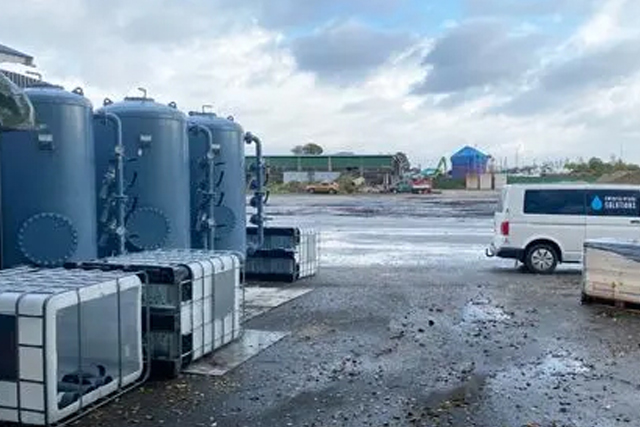
Bo Altenstam
Bo Altenstam AB in Hörby is a licensed waste operator in Sweden handling cable recycling and various types of metal waste.
Questions about PFAS?
Contact our specialists for more information about PFAS and available treatment technologies. We’re happy to help you find the right solution for your needs.