
Oceana – rapid response for treatment of extinguishing and wastewater
When a major fire broke out at Oceana, the new water park at Liseberg—an amusement park in Gothenburg, Sweden—pollutants were released into the firefighting and runoff water. NCC quickly turned to Swedish Hydro Solutions, and within a week, a treatment facility was in place. Using a combination of activated carbon and BioMedia®, the contaminants were effectively managed. Analysis has shown positive results, with the majority of values remaining below reporting limits throughout the facility’s operation, which lasted just over a year before it was decommissioned.
On February 12, 2024, a major fire broke out at Oceana, Liseberg’s new water park, which was then in the final stages of completion. According to the Swedish Accident Investigation Authority, the fire most likely started during welding work on a bypass pipe inside a water slide. The firefighting effort lasted several days and resulted in contamination of firefighting, wastewater, and stormwater.
On July 17, 2024, Liseberg’s board of directors decided, at an extraordinary meeting, that Oceana would be rebuilt. According to Liseberg’s estimates, the reconstruction is expected to take around two years, with Liseberg as the developer and NCC as the main contractor.
System installed one week after request
Even before the decision to rebuild, on March 4, 2024, NCC contacted us at Swedish Hydro Solutions to address the emerging water pollution. Investigations revealed elevated levels of phthalates, copper, and PAHs in the water, among other contaminants.
One week later, on March 12, our treatment facility was up and running. The solution consisted of three activated carbon filters and three BioMedia® filters, along with an insulated filter container designed to efficiently capture a wide range of pollutants.
Photo Oceana, Liseberg: Kigsz, CC BY-SA 4.0 via Wikimedia Commons
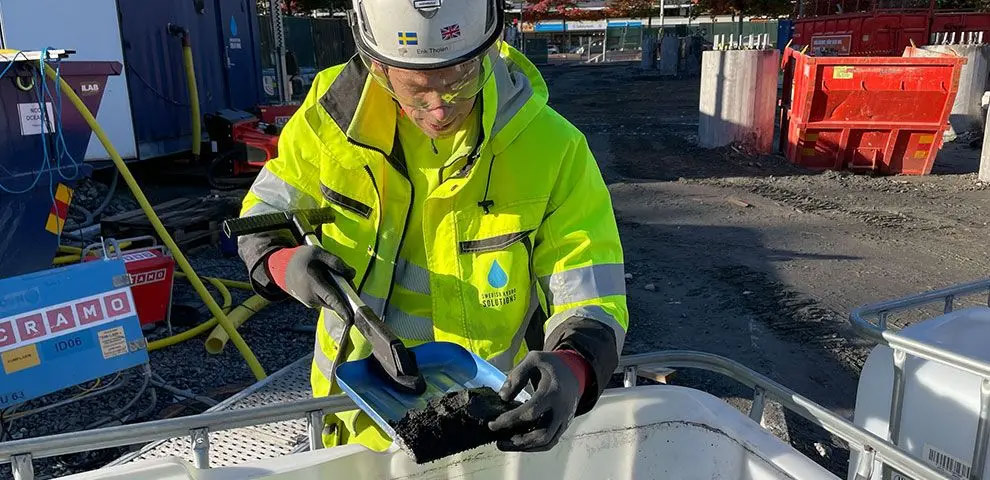
Control of BioMedia filters, Oceana Liseberg
Effective treatment for heavy metals and PFAS
The combination of activated carbon and BioMedia® offers particularly effective treatment of the contaminants that were prevalent in the project. BioMedia® is a uniquely developed filter material made from pyrolyzed wood. The pyrolysis process creates a medium with a large surface area and a high capacity to adsorb and bind substances that need to be removed from the water. It is especially effective against heavy metals such as copper and lead, but also targets a variety of organic pollutants – from oil-based to chlorinated compounds.
Activated carbon complements BioMedia® by effectively adsorbing long-chain PFAS. The combination of these filter materials reduces the risk of quick saturation and extends the lifespan of the system.
One of the advantages of BioMedia® is that filtration occurs by gravity, which reduces the need for energy-intensive pumps. Since the filters are not pressurized, particles accumulate in the top layer instead of being forced into the filter bed. This simplifies maintenance, as the top layer can be cleaned or replaced when necessary, prolonging the life of the filter and reducing the need for frequent replacements.
Analysis results
The treatment facility was decommissioned in the spring of 2025 after operating for just over a year. Analysis results have shown positive outcomes across all measured substances, with the majority of values remaining below reporting limits.
Below is a summary of the project’s analysis results.
Substance |
Unit |
Benchmark |
Avarage value out |
|---|---|---|---|
| Arsenic | mg/L | 0,016 | 0,0035 |
| Benz(o)pyrene | µg/L | 0,27 | Majority BDL |
| Benzene | µg/L | 50 | BDL |
| Lead | mg/L | 0,028 | 0,0017 |
| Brominated flame retardants | µg/L | 0,01 | BDL |
| Cyanide | µg/L | 500 | 0,855 |
| Dioxin | pg/L | 3,1 | BDL |
| Phthalates (total) | µg/L | 8 | BDL |
| Cadmium | mg/L | 0,01 | 0,00014 |
| Chloride | mg/L | 2500 | 38,5 |
| Copper | mg/L | 0,01 | 0,00385 |
| Chromium | mg/L | 0,007 | 0,00232 |
| Mercury | mg/L | 0,07 | Majority BDL |
| Nickel | mg/L | 0,068 | 0,00213 |
| Oil Index | mg/L | 1 | Majority BDL |
| PFAS11 | µg/L | 0,09 | 0,02996 |
| PFOS | µg/L | 36 | 0,000757 |
| Suspended solids | mg/L | 25 | 4,44 |
| TOC | mg/L | 12 | 11,92 |
| Trichloroethylene | µg/L | 10 | BDL |
| Tributylin | µg/L | 0,0015 | BDL |
BDL = Below Detection Limit
More projects
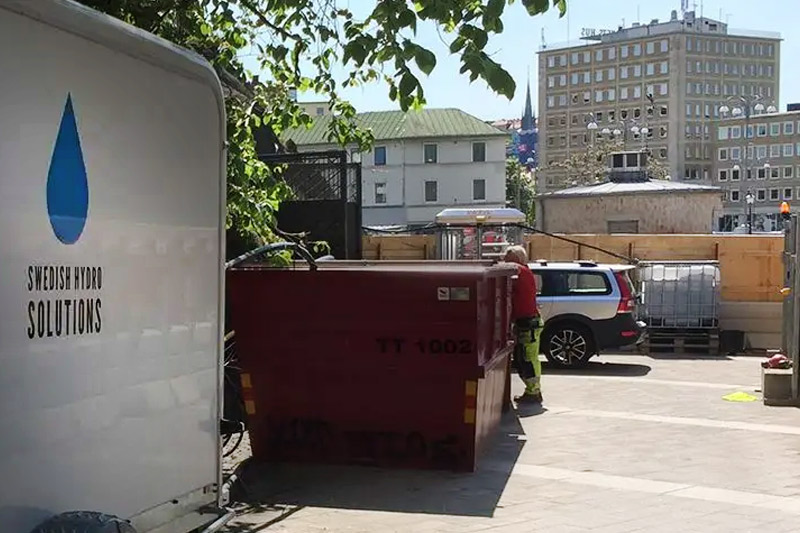
Treatment of drilling sludge
Drilling and wire‑sawing in rock use water for cooling, creating fine drilling slurry. Since runoff enters the Göta River, a Natura 2000 area, turbid water must be prevented.
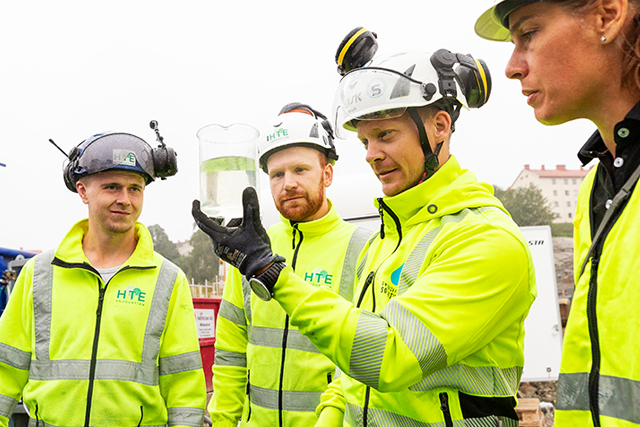
Fix factory
For over 60 years the Fix sign was a landmark in Gothenburg. When the factory closed for new housing, Swedish Hydro Solutions managed the water treatment.
Pre-study West Link
Heavy rain filled the site and excavations, creating a bottleneck and requiring treatment of stormwater containing lead, arsenic, copper, and mercury.
Need more information?
If you’re seeking more insights about our projects designs or want tailored guidance for your unique project, get in touch with our water treatment specialists.